

Evelina Fredriksson
Affärsområdesansvarig region Öst / Director / Sustainability audit and advisory services

Focusing solely on traditional financial risks and opportunities is no longer enough. Growing awareness of sustainable development is placing higher demands on companies to work in a structured and strategic way with sustainability-related issues.
While the new reporting requirements may initially seem extensive, we've found that sustainability reporting, when used correctly, can be effective and create value. Through standardised reporting requirements, the CSRD contributes to greater transparency and comparability between companies, while giving investors and other stakeholders better tools to understand and assess companies' sustainability work, risks, opportunities, and impact on people and the environment.
These requirements mean that sustainability information becomes more accessible to customers, investors, financiers, business partners, suppliers, job seekers, authorities, and other stakeholders, creating better conditions for well-informed decisions. The specific disclosures required and the scope of reporting vary depending on a company's size, industry, and circumstances.
At BDO, we work closely with our customers throughout the entire process, tailoring our approach to the organisation's circumstances, level of maturity, and ambitions. For some organisations, the work is primarily about ensuring regulatory compliance and reporting readiness, while others focus on building structure, strengthening internal processes, or using reporting as a strategic tool for governance and development.
The Corporate Sustainability Reporting Directive (CSRD) is the EU's directive on sustainability reporting. It replaces the earlier Non-Financial Reporting Directive (NFRD) and introduces expanded requirements for how companies identify, manage, and report on sustainability-related matters.
The CSRD introduces the European Sustainability Reporting Standards (ESRS), which specify the disclosures companies must provide and how sustainability information should be structured and presented. The ESRS covers disclosure requirements across environmental, social, and governance-related areas and is built on the principle of double materiality. This means companies must report both how sustainability issues affect their financial position and development, and the impact their operations have on people and the environment.
The ESRS standard sets out the overarching principles for reporting, including the requirement for a double materiality assessment, which forms the basis for identifying a company's material sustainability issues and the associated reporting requirements.
Sweden implemented the Corporate Sustainability Reporting Directive (CSRD) through amendments to the Swedish Annual Accounts Act, which came into effect on July 1, 2024. For the 2025 reporting year, the rules applied to public-interest entities with more than 500 employees.
As things currently stand (2026), the main principle going forward is that mandatory CSRD reporting will primarily apply to very large companies, with the following thresholds proposed/applicable under the Omnibus reform:
Proposed/new main direction following the Omnibus reform
In practice, this means that a large proportion of companies that would previously have fallen within scope under the original CSRD thresholds are no longer expected to be subject to mandatory reporting.
The EU's sustainability reporting standards, ESRS, require companies to carry out a double materiality assessment (DMA). The double materiality assessment is a central part of the work under the CSRD and ESRS framework and aims to ensure that companies identify and report the sustainability issues most relevant to their business and stakeholders. The assessment forms the basis for providing a fair, relevant, and comprehensive picture of a company's sustainability impact, risks, and opportunities.
The purpose of the double materiality assessment is to identify a company's material impacts, risks, and opportunities (IROs) related to environmental, social, and governance (ESG) issues, which must be reported in accordance with the CSRD and ESRS.
The process begins by identifying the company's actual and potential impact, both positive and negative on people and the environment in the short, medium, and long term. The analysis considers sustainability issues deemed relevant based on the company's operations, business model, or value chain. The double materiality assessment also includes an analysis of the company's business model, value chain, current situation, future development, external context, and relevant stakeholders.
A sustainability issue is considered material if it is material from an impact perspective, a financial perspective, or both. This assessment determines which sustainability areas a company should prioritise in its sustainability work and which disclosures become mandatory to report under the ESRS.
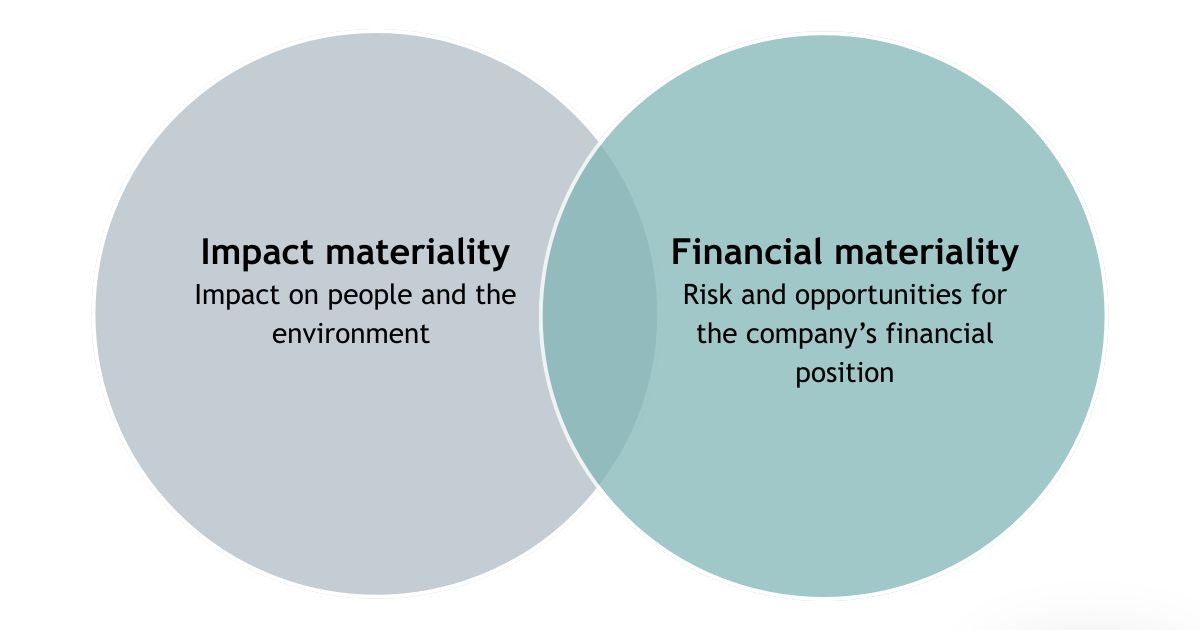
If a company is subject to the reporting requirements under the CSRD, conducting a double materiality assessment is mandatory. The double materiality assessment forms the basis for identifying which sustainability issues are material to the business and must therefore be included in reporting under the ESRS.
We've found that a double materiality assessment can also be valuable in several other situations:
Working with CSRD reporting often requires integrating new types of processes, data requirements, and regulatory expectations into existing structures for governance, risk management, and reporting. For many organisations, this presents both practical and strategic challenges, particularly as the regulatory framework continues to evolve and expectations around transparency increase.
Common challenges in working with CSRD and ESRS include:
Evelina Fredriksson